Key Facts
- Categorized as a Main-belt Asteroid
- Comparable in size to the U.S. state of Maryland (200.00 km diameter)
- Not a Near Earth Object
- Not a Potentially Hazardous Object
- See orbit simulation
Overview
Stonk is a very large asteroid circling the sun between Mars and Jupiter, inside the main asteroid belt. NASA JPL does not treat Stonk as potentially hazardous, because its orbit never carries it near Earth.
One lap around the sun takes Stonk 1,390 days (3.81 years). Over that circuit it swings between 2.06 AU and 2.83 AU from the sun, travelling at an average of 19.11 km/s. At 200.0 kilometers across, Stonk is bigger than 99% of known asteroids — roughly the size of the U.S. state of Maryland.
Stonk has been watched long enough to time its spin: one full turn on its axis takes 7.44 hours.
Its spectral type — G on the Tholen scale, Ch on SMASSII — suggests Stonk holds water, iron, nickel, cobalt, nitrogen, and ammonia.
No Close Approaches
At their nearest, the orbits of Stonk and Earth stay 1.06 AU apart. That is a comfortable margin, and it holds at every point in the orbit.
Orbital simulations run by NASA JPL's CNEOS turn up no close approaches to Earth.
Images and Observations
The orbit of Stonk is pinned down by sightings going back to Sept. 14, 1852, the most recent officially logged on April 3, 2023. The IAU Minor Planet Center holds 8,792 observations behind that solution.
The shape of this object has been modelled:
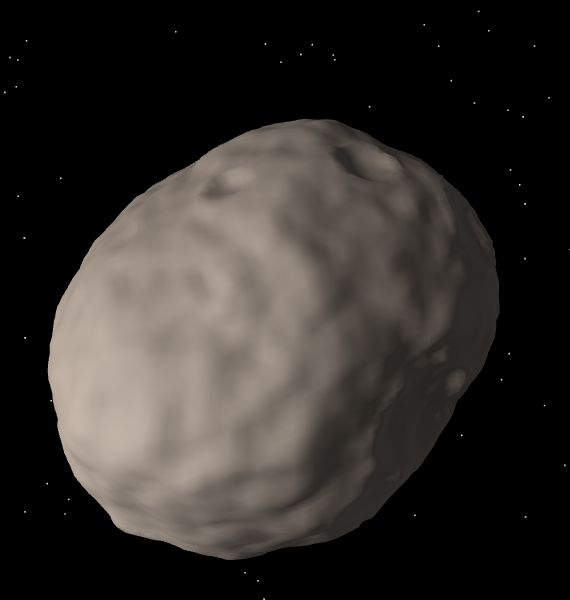
View asteroid Stonk in 3D.
Accessibility and Exploration
The NHATS study does not rate Stonk as a realistic destination for a crewed mission.Similar Objects
These objects follow orbits with much the same shape and tilt as Stonk:References
Search
or view a random objectOrbital Elements
- Epoch: 2460200.5 JD
- Semi-major axis: 2.442 AU
- Eccentricity: 0.1573
- Inclination: 1.57°
- Longitude of Ascending Node: 211.04°
- Argument of Periapsis: 182.59°
- Mean Anomaly: 249.83°
Physical Characteristics
- Diameter: 200.00000 km
- Magnitude: 7.51
- Albedo: 0.037
- Spectral type (Tholen): G
- Spectral type (SMASS): Ch
Derived Characteristics
- Orbit Period: 1,390 days (3.81 years)
- Avg. Orbit Speed: 19.11 km/s
- Aphelion Distance: 2.83 AU
- Perihelion Distance: 2.06 AU
- Rotation Period: 7.44 hours
- Approx. Composition: water, iron, nickel, cobalt, nitrogen, and ammonia
Map Comparison
Orbit Simulation
Sky Map
A ◯ pink circle marks where Stonk sits. It may fall outside your current field of view — use the controls below to change the position, location and time.